Sunday, July 18, 2010

CONFLICT IN THE PACIFIC 1937-1941


SURVEY OF THE STATE AFFAIRS IN THE PACIFIC 1937, INCLUDING THE JAPANESE OCCUPATION MANCHURIA AND US ISOLATION

Rise of Japanese Imperialism:

• Many factors helped foster the development of Japanese imperialism. Some main factors include:
- The need for raw materials
- Population pressures
- Fear of western intentions
- Nationalist indoctrination and militarist influence
• 1904 Japan attacked Russia at Port Arthur. Russo-Japanese war ended in a dramatic Japanese victory that both surprised and impressed the west.
• 1915 China rejects Japan’s twenty-one demands – an ultimatum demanding widespread powers to expand Japanese control of Chinese territory and resource and intervene in Chinese affairs.
• Implementation of Open Door Policy – no one nation should seek special treatment for itself at the expense of others.

Twenty-one demands challenged this policy.
• Japan was now the dominant power in East Asia and it had expansionist ambitions.
• Versailles Peace Conference 1919, US President Wilson contested Japan’s claims to the former German territory it had acquired in China and the Pacific
• Japan opposed by the US and Australia when it proposed all members of the League of Nations (LON) support racial equality.
• Compensation with control of several mandates and temporary control of Shandong
• Washington Conference (Nov 1921 – Feb 1922): danger of a naval race developing (seven important agreements) including:
- Five Power Naval Treaty between US, Britain, Japan, France and Italy to limit size of navies. Japan agreed to limit the number of its battleships according to ratio 5:5:3 for the US, Britain and Japan respectively.
- Nine Power Treaty signed by all the nations at the conference, originally respect China’s independence and Open Door Policy
• The non-renewal of the Anglo-Japanese Alliance was viewed as an insult in some quarters of Japan. Felt the loss of Shandong; Washington Conference was humiliation at the hands of westerners
• Extreme nationalists within army believed Japan should abandon international system, which was dominated by western powers and pursue own interests through military expansion.

Japanese Internal Developments:

• Japanese politics – right wing
• Violence and assassination became frequent, nationalist/militarist/patriotic groups grew and hoped to achieve a restoration of traditional values
• Widespread corruption

Failure of Japanese Liberalism:

• Japanese imperialism had at first supported the Asian revolutionary movement against the West but this was then developed into the armed forced seeing themselves as the champions of Asia to stop the Western powers and create a Co-Prosperity Sphere.
• Political parties functioning were renowned for their corruption and were continually squabbling. The need for a firm government was obvious
• These ‘patriots’ believed that the solution for a weak, political system run by corrupt, squabbling politicians was a loyal, militarist regime guided by the high-minded principles of nationalism, obedience and honour.
• The solution for a depressed economy, in which living standards were plummeting, was a strong militarist regime that would champion the farmer and secure Japan’s economic interests abroad by means of an overtly imperialist policy.

Rise in Japanese Militarism in the 1930s:

• Manchuria
- Northern province of China, occupied by Russia after the Boxer uprising of 1900
- After Russo-Japanese war 1905. Manchuria retuned to Chinese control
- Japanese consolidated their position in Manchuria with the twenty-one demands of 1915 and established significant investments in the area in industrial plants, mines and railways
• Mukden bomb incident
- 18 Sept 1931, middle-grade officers of the Kwantung Army had a section of the Japanese-owned southern Manchurian Railway blown up.
- Chinese were blamed for the incident and the Kwantung Army used it as an excuse to take over the whole of Manchuria.
- Japan placed the last Emperor of China as the puppet Emperor of the new nation of Manchukuo in September 1931. This gave the Japanese further living space and resources, but raw materials proved to be of poor quality.
- China appealed to the LON for assistance; demanded Japan cease operations in Manchuria, Japanese military ignored this demand and civilian government in Tokyo was powerless to act to restrain the Kwantung army conducting own foreign policy

Effects of Manchurian Incident:

• Invasion of Manchuria and subsequent inability of LON to discipline Japan had enormous ramifications both inside Japan and throughout the world
• Wave of patriotism
• Japanese politics now shifted to the right as extremist groups gained further ground.
• Feb 1932 young bloody extremists from League of Blood assassinated Prime Minister Inukai. Assassination virtually ended party governments, as the army would not supply a minister of war if a party leader headed the government. “acting in the name of patriotism…political parties were betraying the true interests of Japan.”
• Leaders of army did not believe in the actions of the young officers but used the circumstances to achieve further political reform to their own advantage
• BY invading Manchuria, Japan broke numerous international agreements, Nine Power Treaty and League Of Nations (LON) Covenant member nations would not resort to aggression in international disputes
• LON only offered mild criticism of Japan’s invasion, March 1933 Japanese resigned from LON.
• Dec 1934 – Japan would no longer abide by the Naval restrictions of the Washington Conference
• Japan now turned away from internationalism and embraced a policy of aggressive expansion

Expansion of Militarism (Army Uprising):

• Within army, feelings of arrogance and pride swept through officer ranks.
• Growing contempt for politicians, some officers began to see political assassination as a logical means of getting rid of them
• PM Inukai’s assassination 1932: 20 army and navy officers who immediately gave themselves up to the police after the killing, portrayed as national heroes and were given light sentences
• Army emerged as a strong political force, gained support of bureaucracy
• Mid-1930s two maries had emerged based around two factions:
- Toseiha (Control Faction): fully mechanised force, conservative modernisers, disliked the radicalism and insubordination of the junior officers, larger and less radical, wished to maintain friendly relations with Soviet Union and make China the target
- Kodoha (imperial way faction): spiritual power of the Emperor’s army was its true source of strength, backed activist officers in the field, ore influential 1932-1934 and more radical, saw war with Soviets more like and not south of Great Wall

February 26 Incident:

• 1500 soldiers, led by junior officers from Kohoda, stayed a coup attempt. Seized the Diet building and several others, and attempted a wholesale massacre of the cabinet. Only 3 ministers died.
• Conspirators declared loyalty to the Emperor, but Hirohito entered into the incident stating that the revels must be crushed within the hour.
• Greater military influence began to infiltrate civilian political life. More military personnel were appointed to the Cabinet and this had a great influence on defence spending.

US Influence in Asia/Pacific:

Manifest Destiny -
- Manifest Destiny said it was America’s obvious destiny to rule the entire North American continent from the Atlantic Ocean to the Pacific Ocean
- IT was an idea that grew out of America’s confidence in the superiority of their democratic society
- Momentum of Manifest Destiny took America beyond the continent of North America
- While consolidating its position in North America, US was rapidly emerging as a Pacific Ocean Power
• Significant events in this development included:
- Commodore Perry’s expeditions to Japan 1853 and 1854, purchase of Alaska from Russia in 1867, formal annexation of Hawaii in 1898 after a long period of US domination, transfer of the Philippines from Spanish to American control, occupation of islands (i.e. Midway, Guam and Wake)
• All these territories gave US a strong strategic position in the Pacific Ocean and provided a series of stopover bases for the long journey between America and China
• US developed strong interest in China in 19th Century Motivated by mixture of self interest and idealism
• 1894 – US Secretary of State, John Hay, called Open Door Policy in China
• Various colonial powers could not stop other countries from trading in their spheres of interests
• Open Door Policy in China would favour USA because its economic strength would allow it to dominate in a free trade environment
• America’s Open Door Policy called upon other nations to respect China’s independence

US Isolationism:

• Refused involvement in European Conflict or power struggles
• ‘we seek no part in directing the destines of the world.” – Warren Harding
• America should not again be drawn into conflict
• Isolationism refers to a policy of avoiding alliances or any involvement with other nations

Neutrality Acts (1935-1937):

• Authorised the President to declare an embargo of up to six months on arms shipments to any nation where a state of war existed
• Also ban any American citizen from travelling to warring countries except at their own risk.
• 1936 this act was extended by adding loans and credits to the banned list
• 1937 Congress extended the Act as a result of the Spanish Civil War; President could determine when a state of war existed or a civil war threatened peace
• Belligerents could only purchase non-military goods and they had to pay cash and transport the goods themselves – cash and carry.
• Such an action avoided the US exposing itself to unrestricted submarine warfare, a reason for American entry into WWI

Losing Influence in the Pacific:

• Japan’s expanding navy after leaving Five Power Naval Treaty in 1936
• Britain and France Germany and Italy; too ill-prepared to worry about potential threat in Asia

Territorial Concessions:

• Japanese: Manchuria, Mariana, Caroline Islands, Marshall Islands, Korea Formosa
• American: Philippines, Midway, Hawaii Wake, Guam
• British: India, Burma, Malava
• French: French Indo-China

JAPANESE MILITARISM 1937-1941 AND US, BRITISH RESPONSES TO IT

Invasion of China and beginning of Sino-Japanese War (July 1937):

• 7 July 1937, the army once again took control of affairs after failing to control events when fighting accidentally took place between Chinese and Japanese troops at the Marco Polo Bridge outside Peking.
• When Japanese insisted on being admitted to the town to find the Chinese said to be responsible for opening fire, the garrison refused them entry. The Japanese brought up artillery and the fighting gradually spread to Peking and Tientsin, which were occupied by early August.

Nanking (Nanjing) Massacre:

• Dec 13 1937: 50 000 massacred in an attempt to escape, refugees trying to cross Yangtze River. Trapped in the east bank because of no transportation. Japanese arrived and shot at the people on the shore and in the river
• Dec 13th 1937: more than 100000 refugees or injured Chinese soldiers; tanks and artillery entered the city and killing people continued, dead bodies covered the two major streets; ‘streets of blood’ as a result of the two day annihilation
• Dec 17th 1937: Japanese arrested anybody who was suspected to be a Chinese soldier. Captives were shot by machine guns, those still alive were bayoneted; Japanese poured gasoline onto captives and burnt them; poison gas was used, invented and exercised inhumane and barbaric methods of killing (shooting, stabbing, cutting open the abdomen…), rampant raping (over 20 000 in 6 weeks), looting & burning.

The New Order in East Asia:

• November 1938: Japanese government led by Prince Konoe issued a declaration which sought to justify Japan’s aggression in China; free the east of Western imperialist
• “In this lies the ultimate purpose of our present military campaign. This new order has for its foundation a tripartite relationship with mutual aid and co-ordination between Japan, Manchuria and China’s political, economic, cultural and other fields.”
• What Japan desires of China is that that country will share the task of bring about this new order in East Asia

Greater Co-Prosperity Sphere:

• August 1940: self sufficient and mutually beneficial economic community. Would be a Japanese controlled political and economic grouping which would be organised to supply the raw materials that Japan needed and to take exports in return.

US Response:

• Refusal to call Sino-Japanese conflict a war because this would have stopped the US supplying China with war materials under the Neutrality Laws. Loans were given to China via the Import-Export Bank
• The US viewed Japanese expansion with alarm; Secretary of Sate Cordell Hull made it clear that ‘relations could not improve unless Japan completely changed her attitude and practice towards our rights and interests in China.”
• Throughout 1939-1940, US kept ‘the door open’ for talks, Japanese saw this action of compromise as weakness and as the US’s unwillingness to fight

British Response:

• Britain was concerned to avoid causing further friction with Japan
• June 1940 the Japanese demanded that Britain close the Burma Road supply route to China; US would not help them if British refused.

Japanese Occupation of Indochina (1940-1941):

• July 1940: demands to construct airfields in northern Indochina from puppet govt. Vichy France
• July 25th: US embargo on aviation fuel exports to Japan
• August 1940: granted Japan economic concessions and use of military facilities in north
• July 1941: invaded southern Indochina
• Seen as first step in planned policy of aggression
• Response: US economic embargoes and supplying Chiang Kai-shek with money/supplies in the hope that an offensive from him would keep the Japanese fully occupied n China and unable to expand elsewhere.
- By August 1941; oil imports reduced by 90% after British & Dutch adopt similar measures


STRATEGIC AND POLITICAL REASONS FOR BOMBING PEARL HARBOUR

Political reasons:

• Japanese ‘war faction’ led by General Tojo; did not favour negotiations
• Talks in Washington were useless for the aims of the two parties were almost diametrically opposed. Japan wanted America to abandon all support of the Chinese government and in return Japan would consider withdrawing from the Axis Pact. America distrusted the Japanese and wanted then to withdraw from Indochina and China.
• US feared a ‘Munich’ and hence apprehensive in negotiations
• Underestimation of the Japanese - belief that they could be easily beaten even if economic sanctions failed

Strategic Reasons:

• Successful attack on Pearl Harbor would delay American entry in a Pacific War for two years; would be in a position of strength as they would also hold the lands of Southeast Asia and the Americans would be able to do little, therefore = negotiations. US would recover but by then Japan would have acquired enough land US would accept a peace offer to avoid costly confrontation
• As they were being denied all vital resources, they needed resources that could be found down south in S.E Asia (Malay for rubber and Dutch East Indies for oil) embargoes only left two potions: losing face and withdraw from China or find resources to continue the war.
• A restoration of pride from the people in the navy, similar to their naval victory against a Russia in 1904.
• Reaffirm the racial pride of the Japanese and demonstrate the vulnerability of the West
• With Britain, France and the Netherlands greatly weakened as a result of the war in Europe, the American fleet was the only obstacle to Japan’s expansion. With the American leet destroyed, Japan could quickly overtake this region
• America would recover but by the time it did, Japanese army - navy would have established a defence perimeter of naval and air bases to protect its vast territory.

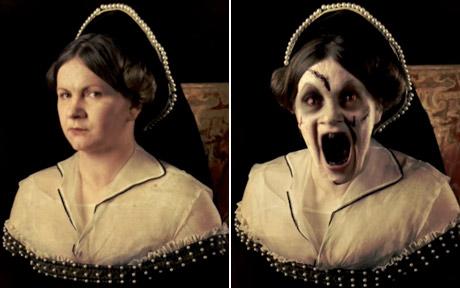
Saturday, July 17, 2010

Bloody Mary Banned in London!


http://www.youtube.com/watch?v=o9WtEmTLp1Y

A digital poster, which was placed on escalators on the London Underground, showed the infamous Queen sitting passively on a chair before suddenly turning into a member of the undead and turning to face towards tube passengers.

Four people complained that the zombie - complete with bloody gashes on her face, rotting teeth and red eyes - had terrified their children.

One man said his eight-year-old child was left terrified by the moving digital poster and another complainant said he had watched scores of kids reel in horror when they saw the poster.

The London Dungeon in south London was promoting a new show called 'Bloody Mary' - the daughter of Henry VIII who reigned between 1553 until 1558.

During that time she had 300 religious dissenters burned at the stake, earning her the title 'Bloody Mary', and dungeon bosses said the object of the ad was to 'show the dark side of her personality and portray her as a villain'.

But the Advertising Standards Authority (ASA) ruled that the poster ad should not be used again as it had 'terrified' children and breached fear and distress guidelines.

It said: "We considered that the morphing image, and the juxtaposition of a calm face with a very scary one, were likely to startle and frighten young children."

"We noted the switch between the passive and frightening face occurred suddenly and unexpectedly, which could increase the shock value.

"We also considered that when the face morphed into the scary character, the bloody gashes, white flesh, rotting teeth, red eyes and the threatening expression meant it was not suitable for young children to see.

"We were of the view that the ad seemed to be setting out to scare and had overstepped the limit of acceptability in doing so because, although not frightening for adults, the image was likely to be shocking to young children and to cause them fear or distress without good reason.

"We concluded that the ad was inappropriate for display in an untargeted medium."

Richard Sampson, 43, a father-of-two from Islington, north London, said: "These posters are totally unsuitable for children to see.

"They are effectively mini-horror movies showing a perfectly normal looking woman suddenly turn into a zombie."

A spokesman for the London Dungeon said that it had planned to use the digital poster during the rest of summer and Halloween, adding: "Bloody Mary killed over 300 heretics during her reign but was one of Britain's lesser known villainous figures, overshadowed by her notorious father Henry VIII.

"The object of the advertising was to show the dark side of her personality and portray her as a villain."

Thursday, July 15, 2010

Happy Day After Bastille Day!


'Colonial nostalgia' accusations taint Bastille Day parade

By FRANCE 24

Troops from 13 African nations marched in Paris Wednesday at the annual Bastille Day celebrations, marking half a century of independence from colonial rule. Their participation has drawn fire from human rights and pressure groups.

Notwithstanding the rain which literally, if not metaphorically, poured on the parade, France marked its annual Bastille Day commemorations Wednesday with pomp, ceremony and carefully choreographed military displays. However, there will be no traditional presidential palace garden party in a nod to the austerity measures being enforced by the French government.

French President Nicolas Sarkozy took the salute during the traditional military parade down the majestic Champs Elysees in the heart of Paris, as troops from 13 former French African countries joined their French counterparts in the march.

The invitations to take part mark the 50th anniversary of independence for the former French colonies, and is also in recognition of the role troops from French colonies played in fighting for France during the two World Wars.
Undaunted by the pouring rain, crowds lined the Champs Elysee as military units, along with an array of tanks and military hardware, swept down the avenue from the Arc de Triomphe, the iconic monument commemorating all those who fought for France, to the Place de la Concorde, from where Sarkozy, accompanied by this year’s guests of honour, watched the parade.

This year’s guests of honour included the leaders of the 12 former French colonies. Ivory Coast's defence minister attended in place of Ivorian President Laurent Gbagbo, while the disputed leader of Madagascar, Andry Rajoelina, was not invited. Malagasy troops however, joined the parade.

Bastille Day marks the storming of the Bastille on the 14th of July, 1789, an event that heralded the start of the French Revolution.

For Sarkozy, the national holiday followed a tumultuous week that saw the French president take to the airwaves Monday for a special prime-time interview to address a growing political donations scandal.

Sarkozy is battling record low approval ratings and an uphill struggle to institute a controversial pension reform plan which will raise the retirement age for public sector workers from 60 to 62. The pension reform is proving particularly unpopular, and Sarkozy is now on a collision course with France’s powerful trade unions.

Furthmore, an expenses scandal earlier this month resulted in the dismissal of two junior ministers and proved particularly embarrassing for Sarkozy as he tries to implement austerity measures.

This year, the French president scrapped the traditionally lavish garden party at the Elysee presidential palace. But the ceremonies were not without controversy.

Protestors along the Champs Elysee Wednesday denounced "Francafrique" - a term referring to a perceived tradition of shady official and business ties between France and its former colonies, some of which are dictatorships.
The Africa commemoration ceremony has been attacked as cynical and tactless by some observers who see it as an unseemly display of France's continuing interference in Africa.

In the lead-up to the Bastille Day commemorations, Sarkozy was forced to defend himself against accusations that, by emphasising France's role in the events of 1960, he was indulging in an unpalatable form of "colonial nostalgia".

"This is a complete misinterpretation," said the president, stressing the "injustices and errors" of the colonial era at a lunch for the heads of state of 12 former colonies. "The aim of this meeting is therefore not to celebrate your independence – you can do that very well yourself," he added. "It is to celebrate the strength of the links which history has woven between our peoples. And the strength of this meeting is to build together our future."

Human rights groups have also warned that some of the African troops participating in the military parade may be war criminals, and the International Federation of Human Rights (FIDH) has called on the French authorities to publish the names of the soldiers taking part.

In an open letter to French President Nicolas Sarkozy, the FIDH said it was, “gravely concerned that some countries’ contingents … may include individuals responsible for serious human rights violations.”

Thimonier Olivier, head of “Survie” (Survival), which lobbies for the redrawing of the French-African relationship, said he was upset by the possibility that “troops who may have committed serious crimes in their own countries could come to France to celebrate a date which is a symbol of freedom”.

Wednesday, July 14, 2010

Love and hate: 'Dancing Auschwitz' videos get a raw response (Glenda Kwek - SMH July 14 2010


"Each year, there are fewer eyewitnesses among us who remember the hell of Auschwitz. And so we are left with the authenticity of the Memorial. Today, this authenticity must bear witness and speak to us so that, in the background, we can almost hear the voices of those who have fallen silent. We must all take care of this place where things happened that left an everlasting mark on our European civilization, and all human civilization. Auschwitz symbolizes the entire history of the Shoah and the whole system of concentration camps. Auschwitz symbolizes the unprecedented high-water mark of evil. We cannot understand ourselves without understanding Auschwitz. Caring for this place is not exclusively an obligation to past generations, to the victims and the survivors. To a large degree, it is also an obligation towards the generations to come." Auschwitz-Birkenau Museum Report 2009

An Australian artist has defended a video of her family dancing at concentration camps in Europe, saying she wanted to "present a fresh interpretation of the past".

Melbourne Jewish artist Jane Korman posted three "Dancing Auschwitz" videos on YouTube in January. One of the videos in which the dancing occurs, featuring Gloria Gaynor's song I Will Survive, received more than 340,000 hits.

The clips were made during a visit to Poland, the Czech Republic and Germany with Ms Korman's father, her niece and her four children in June last year.

One of them showed five family members dancing at Holocaust sites, such as, in front of the "Arbeit macht frei" sign at the gates of the Auschwitz death camp in Poland and at the Theresienstadt concentration camp in the Czech Republic.

Ms Korman's 89-year-old father Adolk, a Holocaust survivor, was one of the dancers.

At one point, he is shown making a peace sign with his fingers and wearing a T-shirt with the word "survivor" across it.

At the end of the video, he is heard saying: "This is a really historical moment. If someone would tell me here, then, that I would come 60-something-three years later with my grandchildren, so I'd say 'What you talking about?' "

Some Jewish people accused Ms Korman of trivialising their suffering at the hands of the Nazis during World War II.

"I don't see how this video is a mark of respect for the millions who didn't survive, nor for those who did," Kamil Cwiok, whose family members died at Auschwitz told Britain's Daily Mail newspaper.

"It seems to trivialise the horrors that were committed there," said the 86-year-old.

But Ms Korman said today that the videos were "very important" to her as she wanted younger generations to "see a different picture of the Holocaust".

"It represents the past, present and future generations," she told Sky News.

"It was very important for me, especially for the younger generations of today so they could see a different picture of the Holocaust compared to what's the normal representation."

She had earlier written on her website that the dance expressed "an attempt at celebrating life, but also evokes absence, loss and mourning".

The artist said she was very nervous when she was filming the family dancing to the music playing on her laptop.

"It was very odd and, at times, it was very uncomfortable," she told the BBC.

"I had to do deep breathing to calm myself and also to tell the others that 'OK everyone snap out of it, we have to dance', which was extremely awkward and uncomfortable."

The video was filmed away from other visitors to the concentration camps as much as possible, Ms Korman said.

But those who did see the family dancing reacted in a way that she did not expect.

"People were moved and started pulling out their video cameras and clapping and applauding. It was a bit surprising ... in the end, people seemed to get it," she told the BBC.

She said reaction to the video after it was put together was overwhelming.

"It's been fascinating. Tons of positive responses and tons of negative responses. Lots of hate messages and lots of love messages and overall it's a very raw picture of world thought towards this issue."

Ms Korman said she was initially nervous at approaching her father about making the dance clips.

"I was a bit nervous at first to explain [to] them the idea but I think it was 15 minutes before our first performance he said: 'Great, we've alive and I'm here with my grandchildren today and let's celebrate.' "

Mr Korman told the BBC the family prayed for the dead at the camps before they danced.

"The dancing was also very important because we are alive. We survived. We were dancing to the song of survival."

http://www.youtube.com/watch?v=EUvo5OHH6o8

I'm not sure what I think about this. I can kind of understand exactly why they did it. I can also understand why a lot of people are really hurt by it.

I am biased. Those of you who have listened to me in class would know that I am not in favour of opening holocaust sites to tourists. I think that they are too important to be simply another stop for a tourist bus. BUT I can also accept how people believe that they must be open to counter the arguments of of holocaust deniers. And these people were not mere tourists.

So over to you! What do you think? Is this appropriate or inappropriate commemoration of the holocaust?

Monday, July 12, 2010

Step One to the 2010 HSC: Forget the sleeping bag. You need the sleeping bear!!!


Most people your age need about 8½ to more than 9 hours of sleep each night. The right amount of sleep is essential for anyone who wants to do well in the HSC. Unfortunately, though, many senior students don't get enough sleep.

Until recently, students in general were often given a bad rap for staying up late, oversleeping for school, and falling asleep in class. But recent studies show that adolescent sleep patterns actually differ from those of adults or kids.

These studies show that during the teen years, the body's circadian rhythm is temporarily reset, telling a person to fall asleep later and wake up later. This change in the circadian rhythm seems to be due to the fact that the brain hormone melatonin is produced later at night for teens than it is for kids and adults. This can make it harder for teens to fall asleep early.

These changes in the body's circadian rhythm coincide with a time when we're busier than ever. For most teens, the pressure to do well in school is more intense than when they were kids, and it's harder to get by without studying hard. And teens also have other time demands — everything from sport and other extracurricular activities to fitting in a part-time job to save money for uni.

Early start times in some schools may also play a role in this sleep deficit. But we have to live with it, and students who fall asleep after midnight still have to get up early for school, meaning that they are only squeezing in 6 or 7 hours of sleep a night. A couple hours of missed sleep a night may not seem like a big deal, but can create a noticeable sleep deficit over time.

This sleep deficit impacts everything from a person's ability to pay attention in class to his or her mood. According to the American National Sleep Foundation’s 2006 Sleep in America poll, more than one quarter of high school students fall asleep in class, and experts have been able to tie lost sleep to poorer grades.

Slowed responses and concentration from lack of sleep don't just affect school performance, though. More than half of teens surveyed reported that they have driven a car drowsy over the past year and 15% of students in the 10th to 12th grades drive drowsy at least once a week.

Lack of sleep has also been linked to emotional troubles, such as feelings of sadness and depression. Sleep helps keep us physically healthy, too, by slowing our body's systems enough to re-energize us after everyday activities.

Even if you think you're getting enough sleep, you may not be. Here are some of the signs that you may need more sleep:

* difficulty waking up in the morning
* inability to concentrate
* falling asleep during classes
* feelings of moodiness and even depression

Here are some things that may help you to sleep better:

Set a regular bedtime. Going to bed at the same time each night signals to your body that it's time to sleep. Waking up at the same time every day can also help establish sleep patterns. So try to stick as closely as you can to your sleep schedule even on weekends. Don't go to sleep more than an hour later or wake up more than 2 to 3 hours later than you do during the week.

Exercise regularly. Try not to exercise right before bed, though, as it can rev you up and make it harder to fall asleep. Finish exercising at least three hours before bedtime. Many sleep experts believe that exercising in late afternoon may actually help a person sleep.

Avoid stimulants. Don't drink beverages with caffeine, such as soft drink and coffee, after 4 PM. Nicotine is also a stimulant, so quitting smoking may help you sleep better. And drinking alcohol in the evening can also cause a person to be restless and wake up during the night.

Relax your mind. Avoid violent, scary, or action movies or television shows right before bed — anything that might set your mind and heart racing. Reading books with involved or active plots may also keep you from falling or staying asleep.

Unwind by keeping the lights low. Light signals the brain that it's time to wake up. Staying away from bright lights (including computer screens!), as well as meditating or listening to soothing music, can help your body relax. Try to avoid TV, computer and telephone at least one hour before you go to bed.

Don't nap too much. Naps of more than 30 minutes during the day may keep you from falling asleep later.

Avoid all-nighters. Don't wait until the night before a big test to study. Cutting back on sleep the night before an assessment task or exam may mean you perform worse than you would if you'd studied less but got more sleep.

Create the right sleeping environment. Studies show that people sleep best in a dark room that is slightly on the cool side. Close your blinds or curtains (and make sure they're heavy enough to block out light) and turn down the thermostat in your room (pile on extra blankets or wear extra warm PJs if you're cold). Lots of noise can be a sleep turnoff, too.

Wake up with bright light. Bright light in the morning signals to your body that it's time to get going.

If you're drowsy, it's hard to look and feel your best. Schedule "sleep" as an important item on your HSC agenda to help you stay creative and healthy.

Nighty night and sleep well munchkins!

Sunday, July 11, 2010

This is my eldest boy - the chef!


So if you are very eating at Spice Temple in the city with friends or family say hello to Brendan and tell him how badly I have taught you! He'll understand!