Monday, April 12, 2010

Forget Chuck Norris! I need Abe Lincoln!

More of me in Dracula Territory!


More things that I have now learned about Bulgarian Vampires!

40 Day Journey of the Dead

Bulgarians believed that spirits of the dead embarked on a journey immediately after death that visited every place they had visited during their life on earth. Their journey lasted for 40 days and then the spirit went on to its next life. However, if the dead were not properly buried, they may find that their passage to the next world was blocked, and might return to this world as a vampire.

How you become a Vampire

Certain people are predisposed to becoming vampires. These included people who died a violent death, those excommunicated from the church, and drunkards, thieves, murderers, and witches. There are stories of vampires who returned to life and started their lives over again in foreign towns, even to the extent that they would marry and father children. ( Actually, I think that I may have taught some! lol) Their only abnormality being their nightly journey in search for blood.

Characteristics of a Vamp

Bulgarian Vampires are renowned for their gluttonous blood drinking and ability to move objects like a poltergeist, and their capacity to produce noises like a firecracker! lol People apparently try to rid their town of them by offering them rich food or excrement!!! Go figure!

Ustrels - Spirits of Dead Children Never Baptised

The ustrel are yet another type of Bulgarian vampire!!! (As if they don’t have enough!!) - the spirit of a child born on a Saturday but who died before being baptized. The ustrel come to life on the ninth day after burial and seek the blood of cattle or sheep. They feast all night and return to their grave before dawn. After 10 days of feeding, the ustrel would become strong enough that it no longer needed to return to its grave. It would rest during the day either between the horns of a calf or ram or between the hind legs of a cow and would attack the fattest animals at night.

To get rid of ustrels, a vampire hunter (vampirdzhija) needs be hired to find the vampire. After the vampire is identified, the community performs a ritual known as the lighting of a needfire. This ritual begins on a Saturday morning. All the fires in the village are put out and the cattle and sheep are gathered in an open space. The villagers then guide the animals to a crossroads where two bonfires stand on either side. This ritual is thought to rid the animal of the vampire that has taken up residence in them and trap it at the crossroads, where wolves devour it! (Makes sense really!!)

How to Kill a Vamp

They use the traditional stake, BUT they also have a method called bottling, where a specialist called a djadadjii chases after the vampire with a holy icon. The djadadjii then drives the vampire towards a bottle that contains its favorite food. Once the vampire is lured into the bottle, it is corked and thrown into a fire. (Simple really!)

Hope that helps all you Stephenie Meyers fans! lol The problem is that these people aren’t laughing when they tell me this stuff! Gulps!!!!

Saturday, April 10, 2010

After spending some time in the Bulgarian mountains I now believe in Dracula!


The following is from - http://vampires.monstrous.com/bulgarian_vampires.htm

Bulgarian beliefs concerning undead vampires are quite varied. Bulgarian names for an undead vampire include: Vampir, Vorkolak, Ouber, Ustrel, …

The pure Bulgarians call this being by the genuine Slavonic name of Upior; the Gagaous (or Bulgarians of mixed race) by that of Obour which is Turkish; in Dalmatia it is known as Wrikodlaki, which appears to be merely a corruption of the Romaic. It seems that the names vampir and obour as used in Bulgaria often mean the same thing.

In one account from Bulgaria translated and quoted in The Darkling by Jan Perkowski, the vorkolak is said to be the soul of an outlaw who perished in the mountains, or in the forest, or along a country road, and whose corpse is eaten by crows, wolves, or some other such scavengers. This soul cannot enter heaven or hell, and so it remains on earth. This vorkolak haunts the place where he was killed. At night, this spirit strangles and drinks the blood of anyone who comes by. The way to rid a place of a vorkolak, is to erect a cross, bless water, and hold a church service at the spot where the outlaw died.

In another account from Bulgaria quoted in the same book, a vampir is a corpse which returns from the grave. A person who died a violent, unnatural death or whose corpse was jumped over by a cat before burial becomes such an undead vampire. (This belief is found all over Eastern Europe where there is belief in undead vampires.) In a case mentioned in this report, a man became a vampir as the result of a fatal fall from a roof. The bones turn to gelatin at first and during the first forty days after burial he performs mischief such as releasing animals from their pens, scatters house hold items, and suffocates people. If not destroyed within the first forty days, the vampir developes a skeleton and becomes even more fierce. At least during the first forty days, the vampir can be destroyed by a Vampiridzhija (a professional vampire hunter) or devored by a wolf. The report doesn't make clear what it takes to destroy the vampire after he develops a skeleton.

A bit of a laugh, for sure, but I wouldn't be sleeping outdoors up here! lol Wooooooooooooooooo! lol

Thursday, April 8, 2010

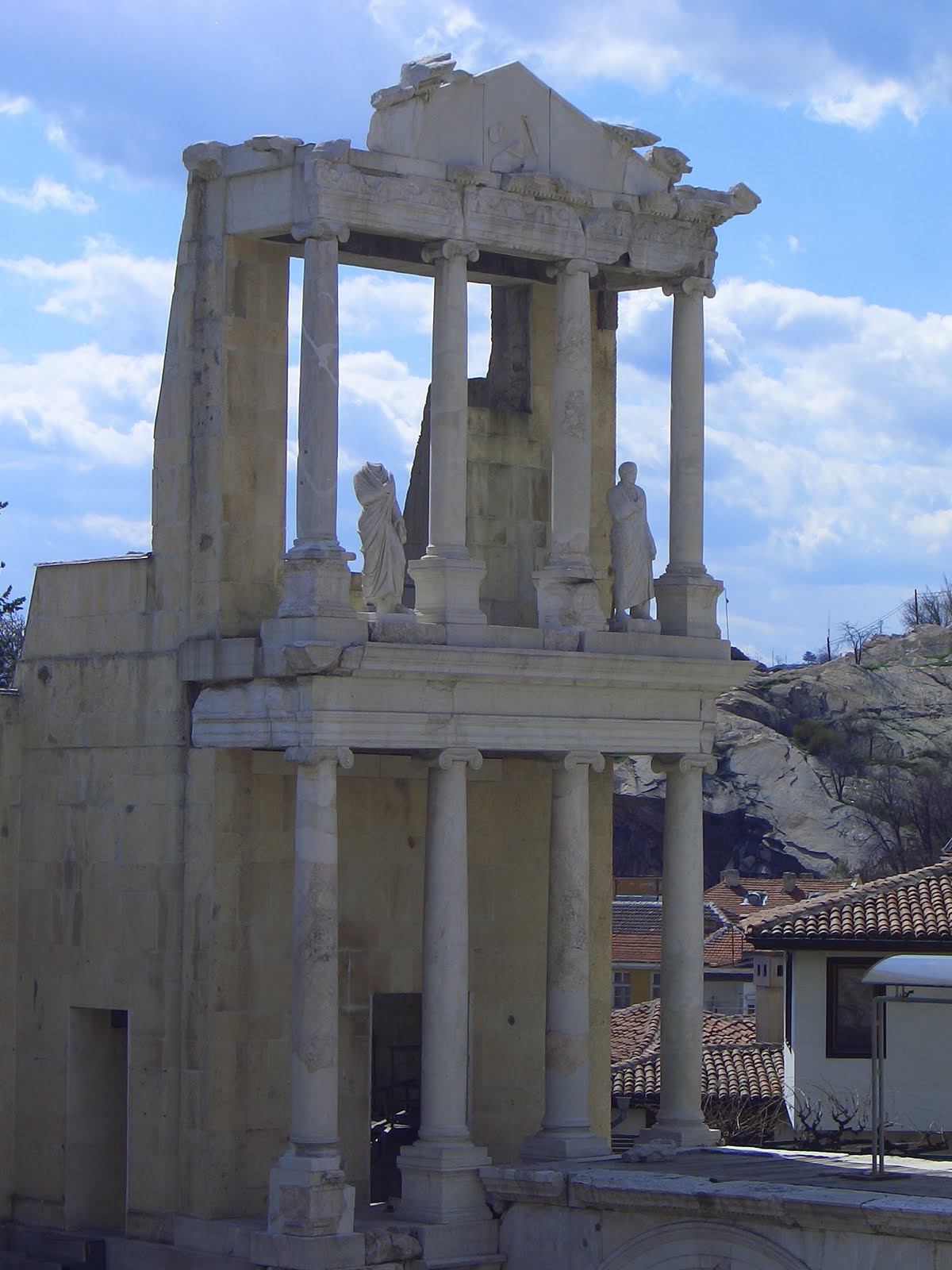
Plovdiv's Roman Amphitheatre


The Roman Amphitheatre in Plovdiv was only found in the early 1970's after a massive landslide. This led to a major archeological excavation, including the removal, over the next 10 years, of earth covering what was left hidden before the landslide.

There was evidence of damage to parts of the amphitheatre by Atilla the Hun when he attacked Plovdiv in the 5th century AD, but in general it is a magnificent structure that has stood the test of time.

It was completed under the rule of the Roman emperor Trajan, and is the largest Roman building in Bulgaria. The amphitheatre stands between the south-western slope of the Dzhambaz Tepe and the Taxim Tepe within the old town.

Built with a capacity of around 7 000 seats, each section of seating had the names of the city quarters engraved on the benches, so the citizens at the time knew where they had to sit.

Just to put things into context, Plovdiv is supposed to be contemporary with Troy and Mycenae, and older than Rome, Athens, Carthage or Constantinople.