Sunday, January 22, 2012

If you aren't getting anywhere with your HEX research, maybe this?


I think that this would make a fascinating subject!

Emmett Till and the Impact of Images
Photos of Murdered Youth Spurred Civil Rights Activism

by NOAH ADAMS

In 1955, Jet magazine published photographs of the mutilated body of 14-year-old Chicago resident Emmett Till, who was brutally murdered in Mississippi. Many civil rights activists say seeing those pictures both haunted and inspired them. NPR's Noah Adams reports on the decision to publish the photos and the wide-ranging effect they had.

Margaret Block, a long-time activist in Cleveland, Miss., was a young girl when the pictures were published. "I remember not being able to sleep when I saw [the photos]," she says. "Can you imagine being 11 years old and seeing something like that for the first time in your life and it being close to home? The death of Emmett Till touched us, it touched everybody. And we always said if we ever got a chance to do something, we were going to change things around here."

For Charles Cobb, a Washington, D.C., journalist and author, the photos were also a catalyst to activism. Cobb first saw the pictures when he was 12 years old. He went on to develop the "Freedom Schools" that mobilized black voters throughout Mississippi in 1964.

http://www.npr.org/templates/story/story.php?storyId=1969702

Monday, January 16, 2012

Changing Attitudes During WW1

HSC Modern History markers love it when a student questions something that is taken for granted.

In the WW1 Section you may get a question on Changing Attitudes During WW1. The accepted version has it that everyone was keen and enthusiastic about the war when it broke out in August 1914 and then as the war wore on they became less and less enthusiastic. It may be worth questioning this and raising the possibility that there may have been a large number of people who were not so positive about the conflict right from its beginning.

Trafalgar Square was the site of two large gatherings of people in the last few days of peace. They had very different characters:


On Sunday August 2nd, a crowd gathered for a rally for peace. The speakers included the bearded former MP for West Ham South, Keir Hardie. Public opinion was divided over the war at the time, many wondering why Britain should get involved in a war rooted in the Balkans and Eastern Europe. Labour politicians like Hardie were vehemently opposed to the war, many were out-right pacifists while others opposed involvement in this specific conflict. Liberals were divided – which was particularly important as they were the government of the day, led by H.H. Asquith. Attorney-General (and Walthamstow MP) Sir John Simon threatened to resign if Britain entered the war, but was talked out of it by Asquith. Unfortunately, it was a wet day.


This was one of the last major public rallies for peace. On the same day, the Germans demanded the right to enter Belgium; this was denied and on 3rd August, then invaded. The invasion of ‘Gallant Little Belgium’ significantly changed public opinion in Britain. Liberals were more inclined to support a war against an aggressive Germany.

Throughout the day on August 4th, people talked about the war. Crowds gathered in Westminster to find out what was going on and to support British intervention in the war.

The crowds were there when Sir Edward Grey, the foreign secretary, sent Germany an ultimatum to leave Belgian soil on that fateful Tuesdsay. These crowds were also filmed. There was still a crowd when the deadline was reached and Britain declared war on Germany at 11pm.


The idea that this was part of a nationwide spirit of ‘war enthusiasm’ has been comprehensively challenged (see Adrian Gregory, Niall Ferguson and Catriona Pennell among others). These crowds were not representative of the nation as a whole – note the youth of the men and the number of straw boaters, these were not the hats of the working classes! (Boaters are also prominent in the peace rally photo as well, of course). It is important to remember that in the days before the radio, people could not get updated news other than in public places – the square, the post office, the cinema or the town hall. People gathered to find out as well as to express opinions (see Jeffrey Verhey’s book on Germany in 1914). Not everyone in London was enthusiastic about the war – but these Westminster crowds certainly were.

Other ‘enthusiastic’ crowds appeared in London – usually trying to see off Territorial Force troops from local barracks. Further afield, people slept through the momentous declaration and woke to discover the news from newspapers and public announcements on the morning of the 5th.

As many times since 1914, Trafalgar Square was central to public displays of opinion. In recent times we can easily recall Trafalgar Square as the site of poll tax riots, anti-war demonstrations and student protests. It has also seen the parade of the Ashes-winning England cricket team and the celebrations of London winning the Olympic games. Many national moments have culminated in gatherings in the square. It is both rhetorically and literally the centre of London.

Thursday, January 5, 2012

Past, Present and Propaganda


By Simon Heffer | Published in History Today Volume: 62 Issue: 1 2012

Simon Heffer argues that until relatively recently most historians have been biased in their efforts to harness the past to contemporary concerns.

I was moved to write my extended essay, A Short History of Power, when I realised, after a lifetime spent reading (and, occasionally, writing) history books, that much of what I had read was simply propaganda. The real reasons why great powers undertook wars or other aggressive policies were often rather unedifying and best dressed up as matters of high principle. Also, many historians have used the struggles of the past to amplify their views about the present.

This is less true with the modern, highly footnoted works of history than with those from the first half of the last century or the centuries before that. By no means is the propagandistic school of history absent from the modern genre – though I should probably attract a writ, if I were to suggest some of the eminent writers who I suspect are guilty of it – but it is harder to get away with blatant skew than once it was. However, from the late 18th to the mid-20th century British historians lived in a golden age of special pleading and downright bias.

I was first alerted to this about 15 years ago when I read, belatedly, James Anthony Froude’s history of the Tudors in the 10-volume Everyman edition. It was published almost a century ago in that format and became enormously popular with Everyman’s target audience of the self-educating lower-middle and working classes. Froude’s facts were as accurate as his researches at the time allowed them to be; but it is his tone that many would find unacceptable today. Through his accounts of the reigns of Henry VIII and his three children, Edward, Mary and Elizabeth, Froude is determined at all times to support the Reformation and to uphold its consequences. He writes of Elizabeth as though she were almost saintly, expressing again and again his detestation of those Catholic (and largely Spanish) plotters who sought to knock her off the throne.

That detestation is nothing compared with what he reserves for Mary Tudor. Not only are her deeds outlined in bloodcurdling detail: Froude frequently makes disobliging remarks about her personality and even her looks. In the far more sectarian world of the mid-19th century, not long after John Henry Newman had gone over to Rome and sought to take numerous other bright younger men over with him, such anti-Catholicism was deemed absolutely acceptable.

History as religious propaganda was nothing new when Froude was writing. Edward Gibbon had put an undercurrent of the support of atheism into the Decline and Fall (1776-89). Thomas Babington Macaulay’s History of England (1848), as well as being propaganda for the Whig interpretation of history – for the notion that history is all about progress – also puts the boot into Catholicism. In an age of imperial expansion there was an insatiable demand for accounts of the English – more than the British – past that described the individualism of the nation and its independence of any foreign power. This is as true of J.R. Green as it is of Froude and Macaulay.

But perhaps the historian I had most in mind when I wrote the essay was Thomas Carlyle, to whom the notion of using history simply to tell a story was, with one exception, utter anathema. The exception is his first attempt at the genre, The French Revolution (1837), in which the author is content just to tell a very dramatic story with such power and colour that it is sometimes as if one is reading a screenplay. After that all Carlyle’s histories have a hidden agenda. Past and Present (1843) is a defence of feudalism and an attack on the modern capitalist England of the Industrial Revolution. Oliver Cromwell’s Letters and Speeches (1845) is used to further Carlyle’s belief in the hero or the strong man and the notion that might is right; as is Frederick the Great (1858-65).

The trait continued into the 20th century, though more among popular than among academic historians. What is Arthur Bryant if he is not propaganda? What point does the school of Marxist historians serve if it is not to propagandise for their shared political view? The Peterhouse school of historians at Cambridge that took its lead from Herbert Butterfield and, like him, took a caustic Tory approach to the Whig interpretation of history, existed (and in some places still exists) to advance a conservative view of the past. Whenever I talk to academic historians they speak keenly of the factions they perceive themselves to be in. History too often is propaganda: all that matters is that we see it for what, at times, it is.

Tuesday, January 3, 2012

New Year Eve 2012?? FAIL!!


Well I have begun my PHD work, in between the cricket of course, and can already see what a hard slog my year might end up being. I will fly through a couple of pages of revision and then spend two days on getting a small section just the way I want it.

I began the New Year with a bang! haha I grabbed an afternoon snack from the fridge on New Year’s Eve and then about 8 pm my tummy started to rumble. At 8.30 pm I began vomiting and spent the rest of the night doing that and sleeping. Food poisoning from Xmas leftovers. No champagne, no fireworks, just the next day hangover without any of the fun of getting it. I do hope it isn’t an omen for 2012 for me!?

Monday, January 2, 2012

Did this "really" cause the the fall of the British Empire?


Elise Foley

elise@huffingtonpost.com

BOONE, Iowa (Can such a place truly exist?? haha)

Rick Santorum said Monday that the United Kingdom's development of a social safety net, including universal health care, cost the nation its empire and "world domination," a mantle he said the United States has assumed but is in danger of losing under Barack Obama.

"If you look at every European country that has had world domination, a world presence, from the French to the British -- 100 years ago, the sun didn't set on the British Empire," Santorum said at an appearance in Sioux City, Iowa. "If you look at that empire today -- why? Because they lost heart and faith in their heart in themselves and in their mission, who they were and what values they wanted to spread around the world. Not just for the betterment of the world, but safety and security and the benefit of their country."

"We have taken up that cause," Santorum added. But now, he said, "We have a president who doesn't believe in America."

Santorum said the United States is being handed to the United Nations under President Obama, who he often says cares about making government bigger, not better, for the American people.

"This is a decision about what kind of America you are going to hand to your children and grandchildren," he said in Boone. "Are you going to leave an America that is more and more dependent on bigger and bigger governments that do the things that families and churches and local communities should do?" as audience members shouted, "No!"

(Well he gets my vote for nut job of the day!)

Sunday, January 1, 2012

"The British class divide is not some beautifully costumed anachronism from a bygone era"


Downton Abbey's just the opiate of the middle classes
Retro porn is no cure for Britain's class ills


Barbara Ellen
The Observer, Sunday 1 January 2012


Please give me a moment, I feel queasy; I think I may have over-indulged in festive TV's comforting class retro-ism. Which means Downton Abbey of course. Not that I mind Downton (a decent enough soap), but it appears to have breathed fresh life into the cultural trend for rosy revisionism.

Then came the darker meat of Charles Dickens's Great Expectations, depicting a social upstart, cowering in the blessed aura of his "betters", only becoming enlightened when things don't go his way.

All over the country, people were marvelling at how the British class system affected everything, back then, in "the olden days", though, strangely, not giving much thought to how it is still affecting a lot of things right now. Well of course not – one couldn't get a nice box set out of that.

I'm always hearing about how the British are obsessed with class, but I don't think that's so. Generally, people seem more interested in a certain brand of retro-class – class from the past, class at a distance, class that can neither touch nor shame them.

It's the same with the sudden literary fascination with servants' hard times below stairs – the surge of books about the poor, callus-handed maids, struggling up the back stairs with their scrubbing brushes and pails. Egalitarian in their way, they also reflect the ongoing cultural cleansing of class issues.

As in, it's fine to be obsessed with class so long as it's aimed at the very top and bottom of society (those conveniently unimaginable extremes) and occurred at least a century (or more) ago.

This way, we all get to enjoy the exquisite gowns and drawing rooms and tut-tut over the servants' dreadful working conditions, from the moral safety of the 21st century.

All of which obscures the fact that class still very much dominates British life.

Only last week, Lord Glasman said that the Oxbridge-heavy Labour party no longer truly reflected the working classes, while David Skelton, deputy director of Policy Exchange, pointed out that none of the three main parties had leaders, or indeed leading figures, from working-class backgrounds.

Away from politics, the richest still appear to be the richest, seemingly untouched by public anger. The middle classes are struggling, primarily to remain middle class (so much more expensive these days!). And the poorest are (natch!) still the poorest, with even the best and the brightest now stuck like never before, not least with free higher education yanked away and triple tuition fees looming.

This is the truth of Britain as it enters 2012. It's riddled with class inequality and its evil twin, poverty, yet what are we all doing – doping ourselves up on what amounts to stately home porn, fast becoming the sedative of choice, the St John's wort of the masses?

It's understandable enough. Modern class issues are real, depressing and make your brain hurt, while fictional retro-class skirmishes make for great family entertainment. It's not nice to think of the many young people unable to remain in education these days… but, woo hoo, did you see that cute Irish chauffeur run away with Lady Sybil in Downton?

Of course, what do we expect from festive television, where escapism will always trump realism? But would it be too extraordinary for people at least to acknowledge that the British class divide is not some beautifully costumed anachronism from a bygone era? Rather, it's something that's still very much with us and not in a cosy book club discussion kind of way.

At the start of 2012, it seems astonishing that anybody thinks they need to refer all the way back to Dickens or, for that matter, Julian Fellowes, for an education in the rights and wrongs of the British class system.

For those who are interested, it's still going strong, all around you, without a box set in sight.

It lives!

The Blog is back for 2012!

Monday, July 4, 2011

The results are in for The Great Victorian Scavenger Hunt 2011!


So is it fame or shame for your Group in 2011???

There was a fair bit of twisting the rules that I didn't let people get away with this time. Pub beer coasters & pie bags do not count as business cards and the "Victoria" signs had to be on Victorian buildings - not on Galleries Victoria, etc... Hand written sings that said "Department of Education" were never going to work.

It does appear that some of you, judging from your pictures, simply treated the day as a chance to pick up men in uniform!! Mmmm

And so to this year's awards:

The Irish Famine Award goes to: Group 4 Lara, Lucia, Lauren, Sarah & Sharon on 633 points. Starving for points in last place, but a brave effort girls - well done!

The Charge of the Light Brigade Award goes to: Group 2 Shanaaz, Connie, Natasha & Jamie on 657 points. Not many left of you standing when the smoke of battle cleared away.

The Prince Albert Award goes to: Group 1 Sophia, Winnie, Carol & Renee on 697 points. A brave effort but your group died way before the end.

The Indian Mutiny Award goes to: Group 3 Maddy, Pearl, Clara & Esme on 745 points. They used every trick in the book, hand made signs, extra group members, fake photos from books, anything & everything to win in the true spirit of the British Empire. But they didn't! Sad really - but the rest of you probably don't think so, lol!

And so....

To first place...

The Queen Victoria Award goes to: Group 5 Bec, Brenna, Kayla & Caroline on 774 points. Congratulations on an outstanding effort. The only group to get to every single location and answer nearly every question correctly. Three cheeers for you!

So have a think about how the game can be improved for the next group.


Hope you had some fun!

Saturday, May 28, 2011

Classified: the Secret History of the Personal Column


There is no longer any shame about being a lonely heart. Upmarket newspapers feature columns of classified ads in which men and women, straight and gay, seek wives or husbands or other thing we won't go into. The most literate are in the London Review of Books: “Well-educated 31-year-old London girl with sultry Mediterranean looks seeks sparkling conversationalist to take her out on an old-fashioned date. Age unimportant, opera tickets optional, good manners essential. Restaurant suggestions and your obscure intellectual passions to kismetxy.”

Apparently, more than 26 million British people used internet dating sites in 2007. There were 14 million users of Facebook; 12 million used Bebo. Classified ads make fortunes for newspapers and magazines – or used to – and can transform the fortunes of their lonely readers.

According to H.G. Cocks, who lectures in history at Nottingham University, the personal column has not always been so uncontroversial. One setback involved Link, founded in 1915 by Alfred Barrett and the first magazine devoted wholly to ads for lonely hearts. Six years later it was suppressed for corrupting public morals. R.A. Bennett, editor of Truth and an anti-prostitution campaigner, complained to Scotland Yard about some of its ads. One was from an “intensely musical” 24-year-old man looking for a “tall, manly Hercules”. There were others using similar code words in their quest for illegal homosexual connections. Soon afterwards the police arrested a man who was found to be carrying passionate love letters from another man and it emerged that their love affair had been kindled in the pages of Link. Barrett was charged with conspiring to enable the commission of unnatural acts and with corrupting public morals by introducing men to women for fornication. He was found guilty and sentenced to two years in prison.

Link may have been the first magazine for lonely hearts but Cocks shows that advertising for a wife or husband has been going on for centuries. He awards the first classified ad – a statement of ecclesiastical rules for the Easter festival – to William Caxton in 1477. But the first lonely hearts ads were published in the 1690s and matrimonial advertising was booming by the early 18th century. As they still are, they were often used to avoid parents or by men and women who were at odds with traditional forms of courtship and morality – at first homosexuals and lesbians, more recently others.

Those in authority, whether religious, political or military, have worried about what is going on between these consenting lonely hearts.

A few women who answered classified ads have got themselves murdered, for instance. Are the ads being used for white slavery? (In some cases, yes.) The military thought it was good for morale when Pte AC White, of the 1st Rifle Brigade – the loneliest man on the Western Front – was sent 800 presents, including 15 tuckboxes and 15 tins of sausages after a personal ad. But when a driver called Pennery, of the Field Artillery, got three sacks of post, one with 3,000 letters, it was too much and they worried about clogging up the post. They worried too that enemy agents would encourage soldiers to give away military secrets and the government banned advertising that invited officers or men to communicate with strangers.

Certain themes persist through four centuries of lonely hearts advertising. One is that however sexually advanced the age seems, there are always hundreds of thousands of lonely men and women in search of a wife or husband or partner. There are also thousands looking for other things. Another is that there are lonely hearts in all social classes.

Cocks believes that the internet has continued and accelerated the trends pioneered by Alfred Barrett. The benefits of anonymity and the opportunism involved in making use of new media, he contends, are still a way of getting beyond traditional types of authority, usually that of the family. The teenagers using Facebook are bypassing parental or social authority in the same way as the women who used personal ads in the 1820s – but self-revelation is now encouraged.

In telling the stories of those who use them, Cocks shows how personal columns were not only a vital way of making friends and meeting lovers but also of forging a community when homosexuality was still illegal, when being single past the age of 21 was seen as embarrassingly shameful and when the difficulty of divorce could make marriage seem an intolerable burden.

Sunday, May 22, 2011

Queen Victoria would not have been amused.


The enormous Cunard oceanliner Queen Mary was supposed to be named after Queen Victoria.

The head of the Cunard Company visited King George V and told him that the new ship would be named after "the greatest of all English Queens."

Before he could get out another word the king replied, "Oh, my wife will be pleased."

And the "Queen Mary" came into being! lol True story!

Socratic Tea Ceremony! Priceless

Wednesday, April 20, 2011

Queen Victoria, or why modern brides wear white!


As a royal wedding approaches it is good to reflect on some of our Year 11 work on Victoria's Empire. You can stun your friends as you watch the coverage - "on every channel"?????!!!! What about Friday night football???


When Jane Austen’s parents were married in 1764, the bride, Cassandra Leigh, wore a red riding habit to the ceremony. Cassandra was not being eccentric or making a fashion statement. Such dress was perfectly appropriate for a young woman from a genteel but not particularly wealthy family marrying a country parson.

Under such circumstances, the wedding dress was a practical garment, expected to be worn again on many occasions. This explained why black was a general favorite for the lower classes. As for the red wedding dress of the ever practical and thrifty Mrs. Austen, it too was used for many years, before being eventually recut as a riding jacket for her son Francis.

Bridal attire in 18th century France was much the same. White was a mourning color, and brides would wear it when they had recently lost a close relative. Otherwise, they dressed in their best finery, and color was a matter of taste and fashion.

But when in 1840 Queen Victoria married her first cousin, Prince Albert of Saxe-Coburg and Gotha, all of this changed. The wedding was of course a momentous occasion, both politically and in terms of fashion.

The bride wore a gown of white satin, trimmed with white lace matching her veil, and a crown of orange blossoms. The only spot of color was the beautiful sapphire brooch Albert had given her as a wedding present.

Queen Victoria was a trendsetter in this regard and soon white became de rigueur for wedding gowns, at least among the upper classes. In France, though, more practical colors remained popular for those of modest means.

Monday, April 18, 2011

Where are we up to???


Year 11 people, did you finish Meiji?


Year 12 people, did you finish Leni?

Friday, April 15, 2011

Dates


Dates have a funny way of imposing a preconceived analysis on the past.

They can function by synecdoche: 1776 for the five years of the American Revolution, 1976 for the punk revolution and its aftermath. Or they can work by metonymy: 1789 stands for the dawn of modernity itself. Choosing a date with no such obvious implications can be gimmicky, but it can also serve a useful methodological purpose, drawing attention to the way we process time and give it meaning.

Mathematically and physically, the passage of time is neutral, any chunk of the past equivalent to any other. We give time meaning subjectively and socially: the first weeks at high school in our mental autobiographies, the Second World War in the social memory of so many nations. These periods of marked time swell up and fill our understanding of the past. Picking an ‘unmarked’ date can force us to rethink the unexamined hierarchies of importance that we assign to past ages and past events. What’s more, because we tend to process the past in terms of narrative, we leave out many things that don’t readily fit into the stories we tell.

By focusing on one ordinary, unmarked year, we can often make sense of the things we usually leave out because they just don’t belong; in the process, gimmick becomes useful method.

Thursday, April 14, 2011

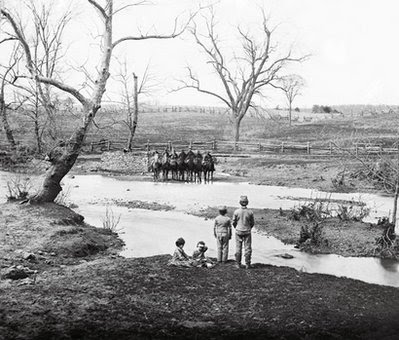
HOW CIVIL WAR PHOTOGRAPHY CHANGED WAR


Civil War photographers completely changed popular perceptions of modern warfare.

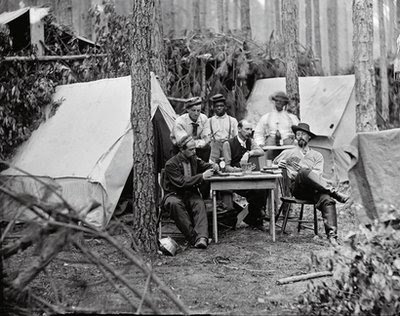
The Civil War = black-and-white images of bearded Union generals or mustachioed Confederate colonels posing to one side of the camera, dead bodies stacked on the battlefield or common soldiers around a camp tent.

Looking back 150 years to the start of the Civil War this month, what impact did photography have on the war? On the people who lived during the time? What do these images tell us today about the soldiers and their families?

Photography changed the war in several ways. It allowed families to have a keepsake representation of their fathers or sons as they were away from home. Photography also enhanced the image of political figures like President Lincoln, who famously joked that he wouldn't have been re-elected without the portrait of him taken by photographer Matthew Brady.

Intense images of battlefield horrors were presented to the public for the first time at exhibits in New York and Washington, many later reproduced by engravings in newspapers and magazines of the time.

"Mr. Brady has done something to bring home to us the terrible reality and earnestness of war. If he has not brought bodies and laid them in our dooryards and along the streets, he has done something very like it," wrote the New York Times on Oct. 20, 1862 about Brady's New York exhibit just a month after the bloody Battle of Antietam.

Photography had been around for over 20 years before the Civil War, but new techniques and commercialization led to its flowering just before conflict broke out. Bob Zeller, president of the Center for Civil War Photography in Abilene, Texas, says the invention of the tintype, which was a metal image, and the ambrotype, printed on glass, allowed for mass production of small photographs usually kept by families in wooden or glass cases.

"It was their most visceral, closest link to their loved ones," Zeller said. "For girlfriends or wives at home, the only thing they had was the ambrotype."

These images were taken by small-town photographers and traveling camp photographers, which combined topped 5,000 by the time war broke out in 1861, Zeller said. More than a million such images were produced during the war.

Officers had their photos taken as well and often passed them out to the men as a morale booster. New ways to reproduce photos gave birth to cards. The Library of Congress has produced an exhibit of soldier's portraits April 12 called "The Last Full Measure," based on a private collection.

The second kind of photo was the carte de visite. The carte de visite, or cdv, was also primarily a portrait photograph, except it was made with a glass, wet-plate negative, which meant unlimited copies could be created. Prints were made on albumen paper, according to the center. These portraits of generals, statesmen, actors and other celebrities were mass produced and given out like trading cards.

Some of the Civil War photographers, including Brady, have been criticized in recent years because it appears they moved corpses to create more graphic images. But Zeller said it wasn't a common occurrence. Given that each photographer need an entire wagon worth of equipment and chemicals, he said, these post-battle photographers faced their own set of challenges.

"Each time they moved, they had to secure bottles of chemicals and plate," Zeller said. "Each time they stopped, it had to be level." Photographers also battled flies that were attracted to photo chemicals, ether that made them woozy, and the stench of death.

"How they were able to look at the scenes of dead bodies and be calm enough to set up their equipment and try to portray reality, there is an unsung heroism there," said Alan Trachtenberg, retired professor of American history at Yale University. "It takes guts to do that."

Trachtenberg said military leaders on both sides also hired photographers to gain intelligence about enemy emplacements, roads, bridges and railroads.

Images of everyday life are also depicted for the first time in the Civil War, men playing cards, playing instruments or cleaning equipment. Black soldiers and slaves were also depicted for the first time, according to New York University professor Deborah Willis.

"The placing of the images was significant in identifying that black soldiers found their place in the war," Willis said. "They were working as soldiers and laborers. The fact is they also placed looked as if there are looking for hope."

Saturday, April 9, 2011

I should be a spy!


Had dinner at "Frontline" tonight (the Foreign Correspondents Club in London) and sitting two tables away was Julian Assange the WikiLeaks guy.

The CIA might not be able to find him, but I did. lol

Thursday, April 7, 2011

A 5,000-year-old gay caveman?


Five thousand years after he died, the first known gay caveman has emerged into the daylight.

According to archaeologists, the way he was buried suggests that he was of a different sexual orientation.

The skeleton of the late Stone Age man, unearthed during excavations in the Czech Republic, is said to date back to between 2900 and 2500 BC.

During that period, men were traditionally buried lying on their right side with the head pointing towards the west; women on their left side with the head facing east.

In this case, the man was on his left side with his head facing west. Another clue is that men tended to be interred with weapons, hammers and flint knives as well as several portions of food and drink to accompany them to the other side.

Women would be buried with necklaces made from teeth, pets, and copper earrings, as well as domestic jugs and an egg-shaped pot placed near the feet.

The 'gay caveman' was buried with household jugs, and no weapons.

Archaeologists do not think it was a mistake or coincidence given the importance attached to funerals during the period, known as the Corded Ware era because of the pottery it produced.

'From history and ethnology, we know that people from this period took funeral rites very seriously so it is highly unlikely that this positioning was a mistake,' said lead researcher Kamila Remisova Vesinova.

'Far more likely is that he was a man with a different sexual orientation, homosexual or transvestite. What we see here does not add up to traditional Corded Ware cultural norms.'

An oval, egg-shaped container usually associated with female burials was also found at the feet of the skeleton.

Another member of the archaeological team, Katerina Semradova, said that colleagues had uncovered an earlier case dating from the Mesolithic period where a female warrior was buried as a man.

She added that Siberian shamans, or witch doctors, were also buried in this way but with richer funeral accessories appropriate to their elevated position in society.

'This later discovery was neither of those. We believe this is one of the earliest cases of what could be described as a transvestite or third-gender grave in the Czech Republic.'